

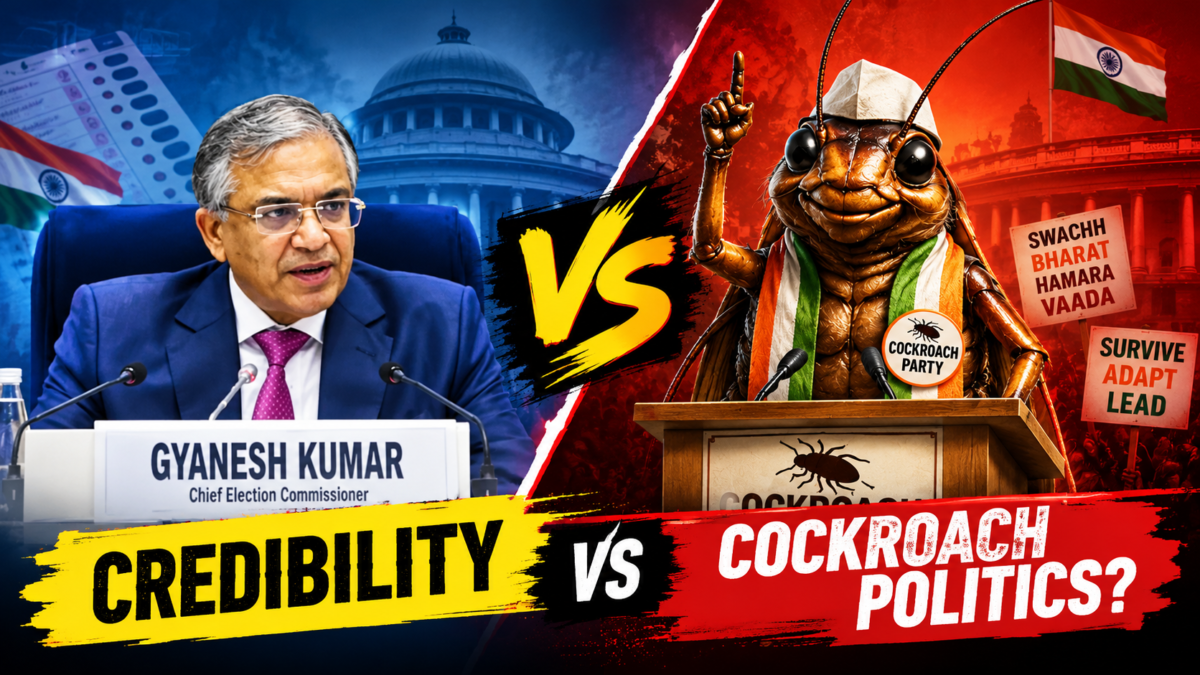
India’s Gen Z-led Cockroach protesters have returned on the streets with a fresh political demand calling for the removal of Chief Election Commissioner Gyanesh Kumar, raising concerns surrounding the Special Intensive Revision (SIR) of electoral rolls.
The protest movement has intensified and the Cockroach Janta Party (CJP) founder Abhijeet Dipke has called for the resignation of the CEC. The group has also announced another protest on October 10, which it has termed “Jantar Mantar 2.0.” The protesters are seeking greater transparency in the functioning of the Election Commission and raising questions over the implementation of electoral revision.
Earlier, on October 2, the CJP organised a major protest at Mumbai’s Shivaji Park. Separately, several opposition leaders staged a protest in Delhi, raising questions about the verification process, documentation, and the inclusion or exclusion of voters.
Gen Z-led CJP Announces ‘Jantar Mantar 2.0’
As the Cockroach protesters feel that the central government does not appear serious about this issue; consequently, Abhijeet Dipke has intimated that they will stage another protest similar to the one previously held at Jantar Mantar. Calling the proposed gathering “Jantar Mantar 2.0,” Dipke has urged supporters to join the campaign and reiterated the demand for the Election Commissioner’s resignation.
The group has also indicated that the upcoming demonstration will focus on its concerns over SIR and what it describes as the need for greater transparency and accountability in the electoral process.
The announcement comes as concerns over electoral-roll revisions continue to feature in the wider political debate, with opposition parties and other groups also questioning aspects of the electoral revision exercise.
Why has the Controversy Developed?
The controversy surrounding SIR is regarding the revision of electoral rolls. According to reports, the opposition questioned how electoral rolls are being revised to make sure that the voter list shows only people who are allowed to vote.
The revision of rolls is meant to keep voter lists fresh and fix problems. To eliminate duplicate names, shifted entries, or other ineligible records. The effort has also sparked political and public debate about how the verification process is carried out.
Critics of the exercise have voiced worries about the paperwork and verification rules and about the chance that true voters might be left off the rolls. Protesters are asking for safeguards so that real voters are not excluded during the revision.
The issue has now moved beyond a technical task about electoral rolls and has become a wider political debate about voter rights, transparency and the accountability of the Election Commission.
Protests Bring Election Commission Under Spotlight
The CJP-led protests come at a time when the Election Commission is facing increased political scrutiny over the SIR exercise.
Separately, the opposition has also raised allegations of irregularities and called for greater transparency in the functioning of the Election Commission. Meanwhile, the EC remains responsible for maintaining and revising electoral rolls as part of its constitutional mandate.
The coming together of protests by the Dipke-led Party and opposition parties around concerns over SIR has brought renewed attention to the electoral-roll revision process.
Who is the Chief Election Commissioner (CEC)?
Gyanesh Kumar is the current CEC of the Election Commission of India (ECI), which is responsible for conducting elections across the nation. The CEC, also referred to as “first among equals,” leads a three-member commission which also includes Sukhbir Singh Sandhu and Vivek Joshi.
Process of Removal of the CEC in India
ThIf the matter comes before the court, the process of removing the CEC becomes quite complex. The constitutional process for removing an Election Commissioner in India is as follows:
- Constitutional Provision: Article 324(5) states that the CEC can only be removed in the same manner as a Supreme Court judge.
- Grounds for Removal: The CEC can be removed for proved misbehavior or incapacity.
- Motion in Parliament: A motion alleging misbehavior requires support from at least 100 Lok Sabha MPs or 50 Rajya Sabha MPs.
- Inquiry Committee: Once admitted, an inquiry committee investigates the allegations.
- Two-Thirds Majority: The motion for removal of the Election Commissioner must receive a two-thirds majority in both Houses of Parliament.
- Presidential Order: After approval by Parliament, the President issues the removal order.
So far, since independence, no CEC has ever been impeached in India and previous motions for removal have also been rejected.
Conclusion
For the Cockroach protesters, the October 10 demonstration is being projected as the next major step in their campaign. The group is expected to reiterate its demand for the removal of the Election Commissioner and press for greater transparency in the implementation of SIR.
With “Jantar Mantar 2.0” now scheduled for October 10, the scale of the mobilisation and the response from political and electoral authorities will determine whether the campaign gains further momentum in the days ahead.